Point
A concrete detail that enters the map: a person, place, object, or other specific presence. A point begins as an observation, not a conclusion.

What if your dreams do not begin again every night?
KKUM begins with one premise: the people, places, objects, feelings, and relationships that return across your dreams may belong to one continuous personal world. Record what survives the morning. KKUM watches what comes back.
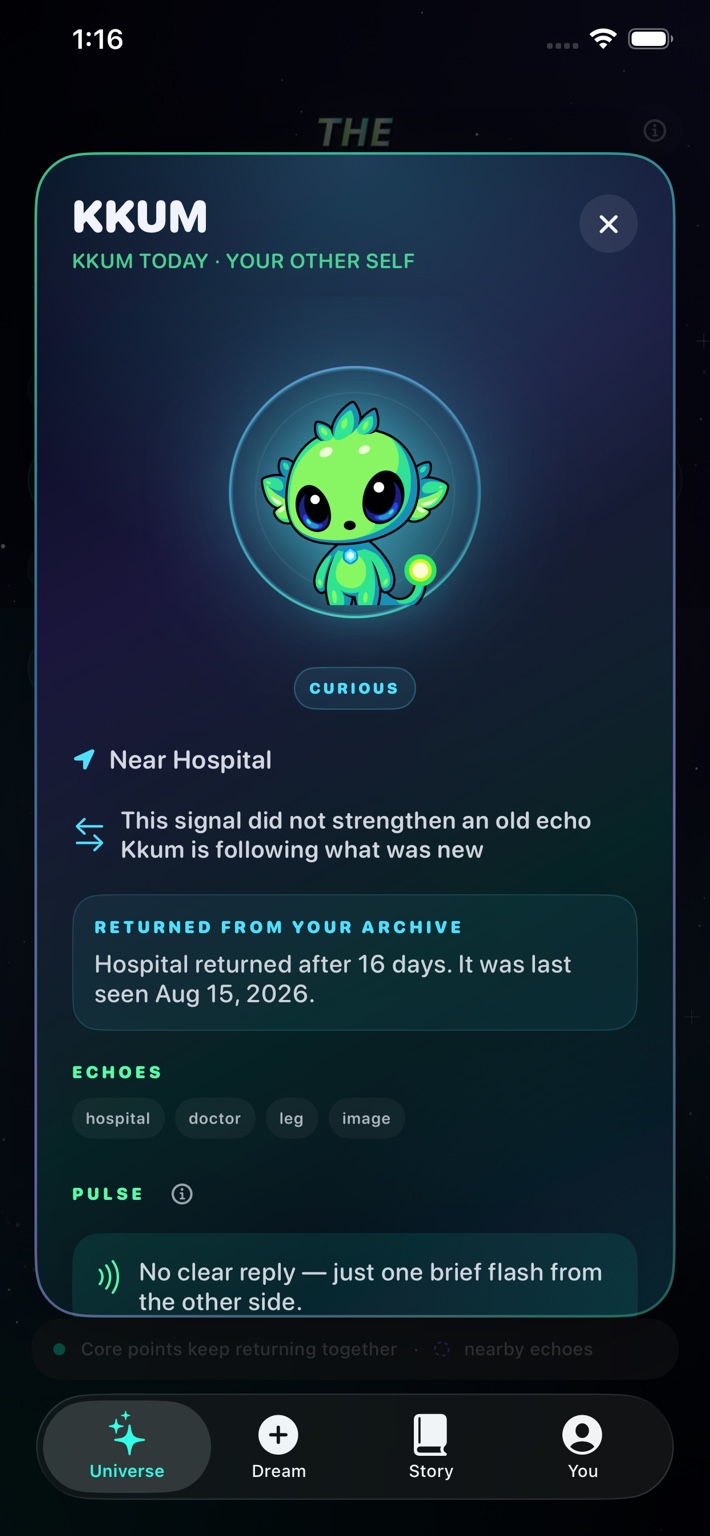
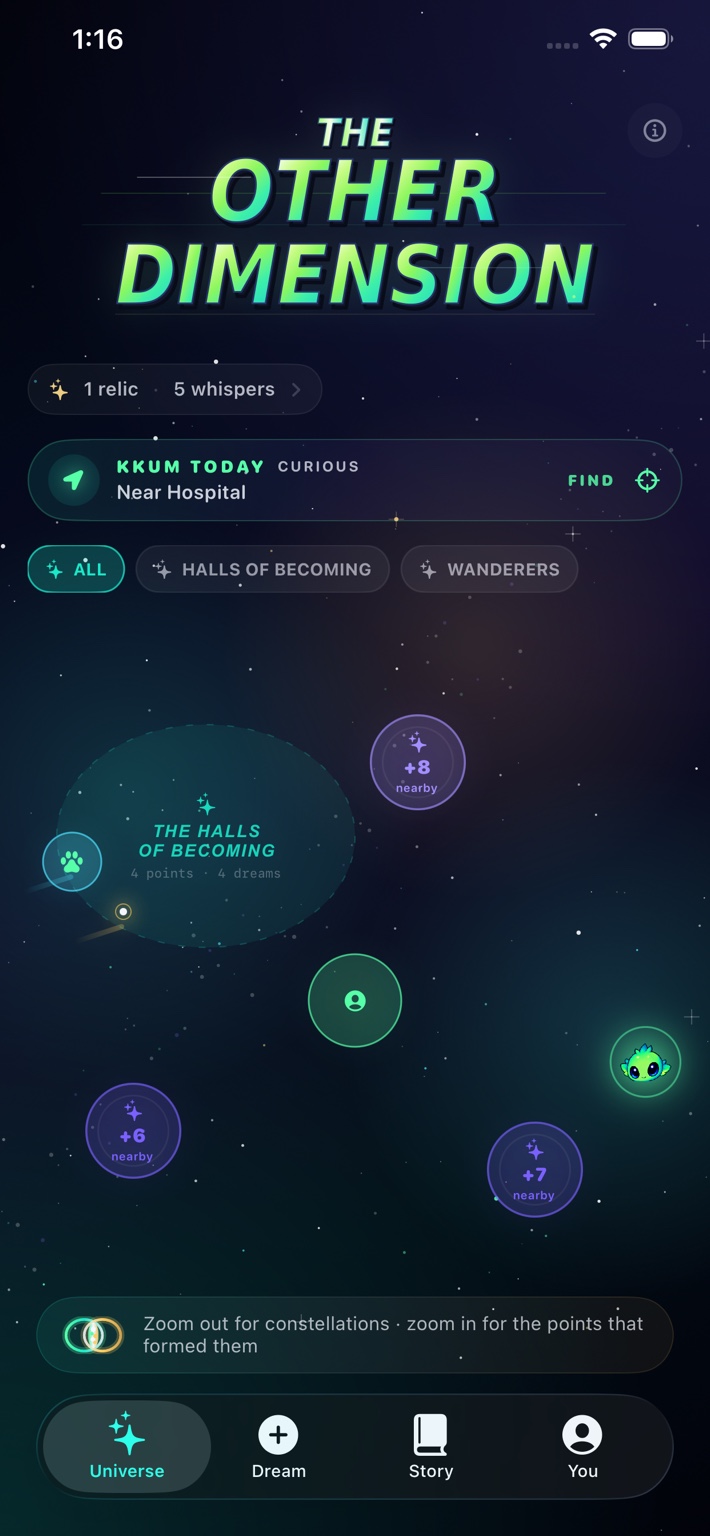
A hospital appears last week and returns tonight. A teacher, a bus, a house, or a stranger crosses back months later. Most dream journals preserve those nights as separate entries. KKUM asks a different question: what if the recurrence matters more than the isolated symbol?
KKUM does not claim that another dimension literally exists. “The Other Dimension” is the app’s narrative model for exploring continuity in your own dream archive. It gives recurring dream material a place to accumulate without pretending that one universal dictionary can explain everyone.
“Only what you remember survives the crossing.”
Dreams arrive incomplete. A face is missing. A room changes shape. A sequence survives but the reason does not. KKUM treats that incompleteness as part of the record rather than filling every blank.
Write a place, a person, a feeling, or a whole narrative. One detail is enough to begin. Your original words remain the anchor before any reading is shown.
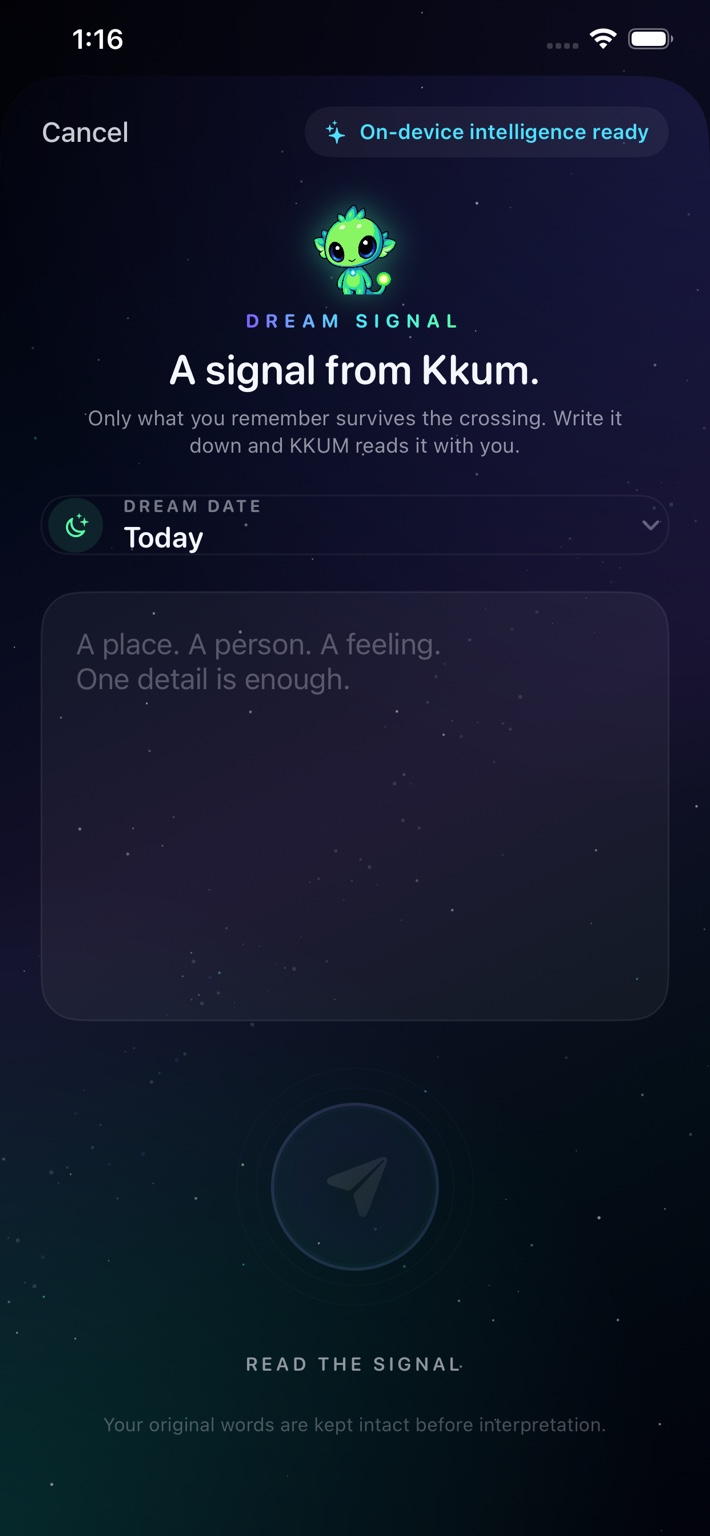
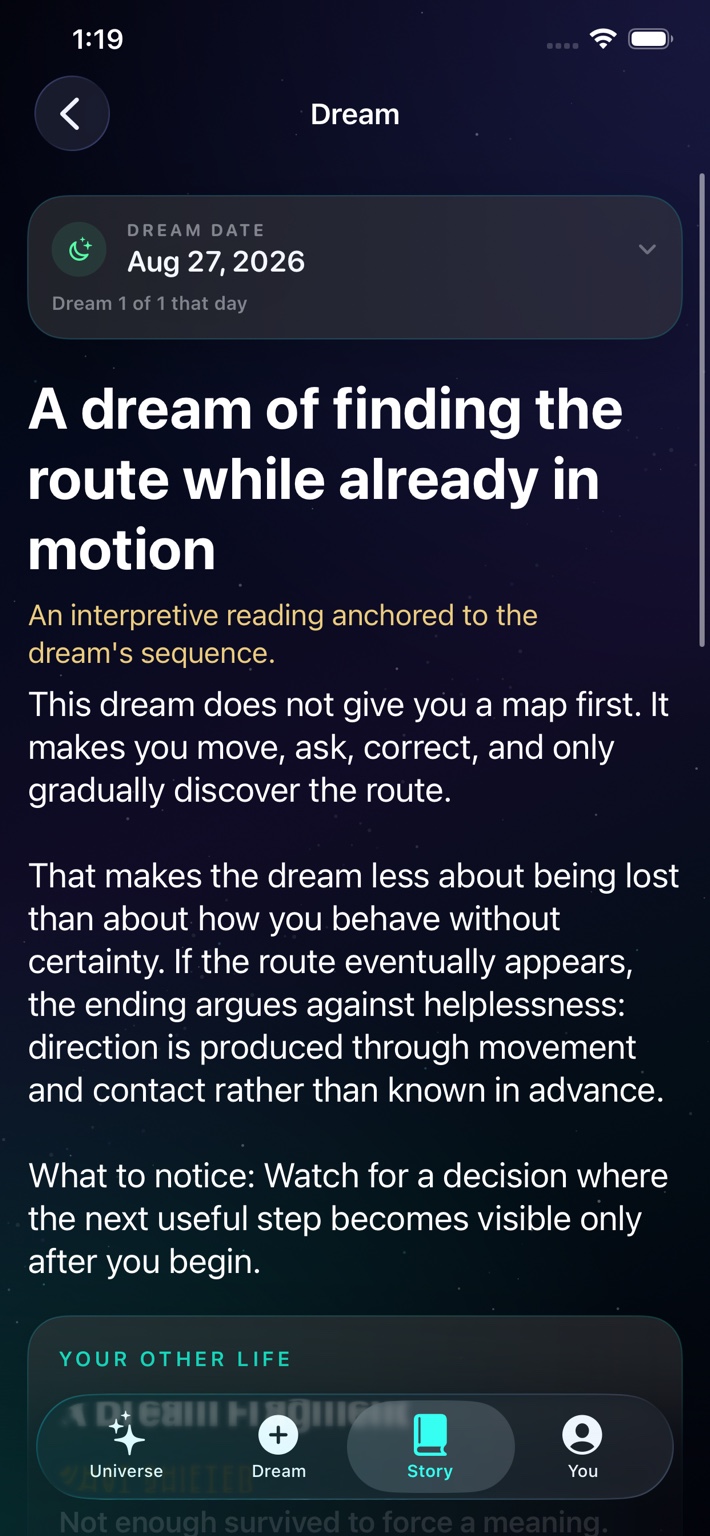
KKUM does not begin with a fixed dream-symbol dictionary. A train, ocean, teacher, ring, hospital, or animal can play a different role in different lives. The app looks at what happened in this dream and what has actually returned in your earlier dreams.
When there is not enough evidence, KKUM is designed to leave the fragment unresolved. When something returns, the older context can change how the new dream is read. The goal is not certainty. It is a longer memory than a single morning.
These are not decorative labels. They describe different levels of evidence in the dream archive.
A concrete detail that enters the map: a person, place, object, or other specific presence. A point begins as an observation, not a conclusion.
A point that has not yet found a stable repeated relationship. Wanderers remain visible without being forced into a pattern.
A recurrence beginning to become noticeable, but not strong enough to name as a structure. A clue before a pattern.
An object that crosses through the archive more than once. Its importance comes from return, not from a universal symbolic meaning.
A repeated network. It forms when related points keep returning together across different dreams. Frequency alone is not enough; the relationship must recur.
The moment material from an older dream appears again in a newer one. Crossings are where the archive begins to behave like a connected history.
One repeated word does not make a constellation. KKUM waits for concrete points to return together across dreams. Until then, they wander.
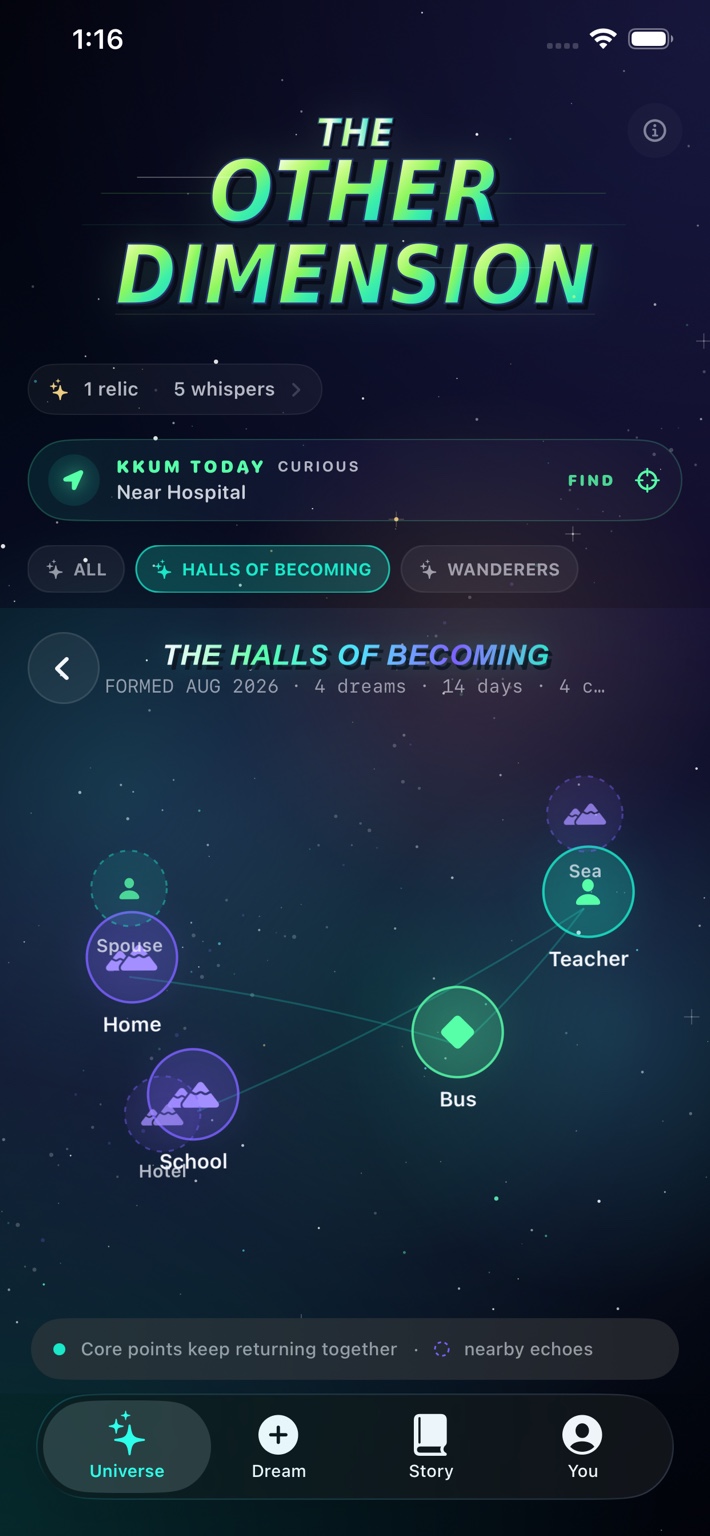
Zoom out to see constellations. Zoom in to see the points that formed them.
In the fiction of the app, Kkum is the other-facing side of you: not a replacement, not a character you command, but a presence inferred from the latest signal.
Think of two faces of one solid. They cannot look directly at each other, yet they belong to the same object. The map does not let you drag Kkum into a preferred location. KKUM estimates where your other self may be from what the newest dream carried back.
You can rename your other self. “Kkum” is simply the default.
A symbol is considered in the context of the dream and the user’s own archive, rather than reduced to a fixed “X always means Y.”
The early universe can be sparse. That is intentional. A return cannot be claimed before anything has returned.
Not every dream needs a grand meaning. KKUM can preserve ambiguity until later dreams provide more context.
Recurring people, places, objects, actions and relationships matter because they appear in your records, not because a generic list says they should.
When the app misunderstands a point or relationship, correction is part of building a more faithful personal archive.
Dream analysis is designed to happen on device. Optional sync uses your private iCloud account; KKUM does not require a separate IMPLEMON account.
Record what survived. The universe begins with isolated details and very little certainty.
Older people, places, objects and relationships begin to reappear. The archive starts remembering across nights.
Stable networks emerge only after related points return together strongly enough to justify a pattern.
The interesting question becomes less “What does this dream mean?” and more “What keeps returning in the life I dream?”
People often search for the meaning of recurring dreams, recurring people in dreams, repeated places, houses, schools, hospitals, oceans, transportation, animals, death, being lost, or finding a route. KKUM is built for that curiosity, but takes a deliberately personal approach: it records when something returns, what it was connected to, and how its role changed across your own dreams.
That makes KKUM both a dream diary and a long-term pattern journal. It can be used by people interested in dream journaling, personal symbolism, mythology, tarot, astrology, spirituality, narrative psychology, or simply the strange continuity of their own sleeping life. KKUM does not present its readings as medical, psychological, scientific, or supernatural predictions.
Private dream journaling for iPhone. Preparing for App Store launch.